County revamps transportation policy to boost development
September 13, 2024 | Montgomery County, Maryland
This article was created by AI summarizing key points discussed. AI makes mistakes, so for full details and context, please refer to the video of the full meeting. Please report any errors so we can fix them. Report an error »
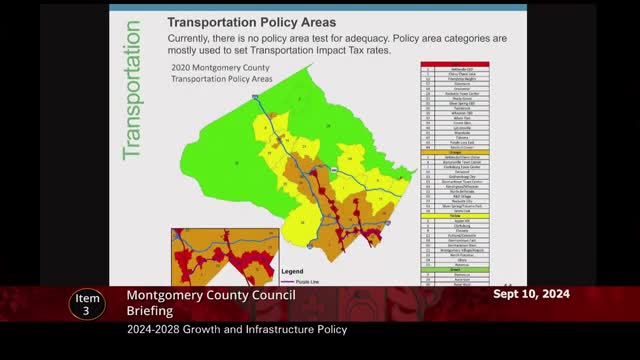
During a recent government meeting, officials discussed significant updates to the county's transportation policies, focusing on the adequacy of transportation facilities in relation to new developments. The meeting highlighted the framework used to assess transportation adequacy, which is categorized into various policy areas represented by a color-coded map indicating transit access and density.
The county has shifted from a broad adequacy test for entire policy areas to a more localized approach, utilizing the Local Area Transportation Review (LATR) for projects generating 50 or more peak hour person trips. This review assesses the adequacy of nearby public facilities, with developers required to make improvements if facilities are deemed inadequate. If construction is impractical, developers can opt for mitigation payments to fund necessary improvements.
Key changes to the transportation policy were outlined, including the introduction of non-motor vehicle adequacy tests, which assess factors such as ADA compliance and pedestrian comfort. These updates aim to create a more comprehensive evaluation of transportation needs beyond just motor vehicle traffic.
Notably, bioscience developments are currently exempt from LATR studies, and motor vehicle adequacy tests are not required in designated red policy areas. The meeting also discussed the establishment of Unified Mobility Programs (UMPs) in certain areas, which consolidate anticipated improvements and require developer contributions.
The evolution of these policies reflects a shift towards a more integrated approach to transportation planning, emphasizing the importance of accommodating diverse transportation modes and ensuring that infrastructure keeps pace with development. As the county continues to refine its transportation strategies, these discussions will play a crucial role in shaping future growth and infrastructure initiatives.
The county has shifted from a broad adequacy test for entire policy areas to a more localized approach, utilizing the Local Area Transportation Review (LATR) for projects generating 50 or more peak hour person trips. This review assesses the adequacy of nearby public facilities, with developers required to make improvements if facilities are deemed inadequate. If construction is impractical, developers can opt for mitigation payments to fund necessary improvements.
Key changes to the transportation policy were outlined, including the introduction of non-motor vehicle adequacy tests, which assess factors such as ADA compliance and pedestrian comfort. These updates aim to create a more comprehensive evaluation of transportation needs beyond just motor vehicle traffic.
Notably, bioscience developments are currently exempt from LATR studies, and motor vehicle adequacy tests are not required in designated red policy areas. The meeting also discussed the establishment of Unified Mobility Programs (UMPs) in certain areas, which consolidate anticipated improvements and require developer contributions.
The evolution of these policies reflects a shift towards a more integrated approach to transportation planning, emphasizing the importance of accommodating diverse transportation modes and ensuring that infrastructure keeps pace with development. As the county continues to refine its transportation strategies, these discussions will play a crucial role in shaping future growth and infrastructure initiatives.
View the Full Meeting & All Its Details
This article offers just a summary. Unlock complete video, transcripts, and insights as a Founder Member.
✓
Watch full, unedited meeting videos
✓
Search every word spoken in unlimited transcripts
✓
AI summaries & real-time alerts (all government levels)
✓
Permanent access to expanding government content
30-day money-back guarantee
