City plans bold transformation for walkable neighborhoods
September 24, 2024 | Ann Arbor City, Washtenaw County, Michigan
This article was created by AI summarizing key points discussed. AI makes mistakes, so for full details and context, please refer to the video of the full meeting. Please report any errors so we can fix them. Report an error »
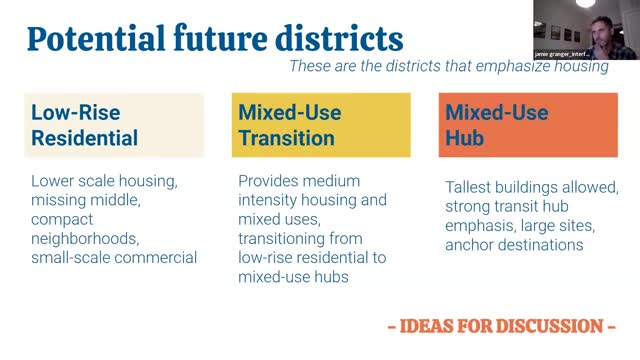
In a recent government meeting, city planners presented a vision for a low-rise residential district in Ann Arbor, emphasizing the need for more diverse housing options and small-scale commercial spaces. The proposed plan aims to introduce \"missing middle housing,\" which includes residential buildings of up to three stories, with potential for four-unit configurations. This initiative seeks to address the growing demand for affordable housing while maintaining the character of existing neighborhoods.
The discussion highlighted a mixed-use transition area that would serve as a bridge between low-rise residential zones and the denser mixed-use hub located in the downtown TC 1 district. This hub is expected to accommodate taller buildings and better transit access, aligning with the city's broader goals of enhancing urban density and accessibility.
Planners also introduced the concept of \"complete neighborhoods,\" referencing the \"20-minute neighborhood\" model, which aims to ensure that residents can access essential services—such as grocery stores, parks, and schools—within a short walking distance. The analysis conducted by the planning team revealed areas of the city that currently meet these criteria and identified gaps where infrastructure improvements are necessary to enhance walkability.
The meeting underscored the importance of integrating transit planning into future developments, particularly with proposed investments in bus rapid transit. This integration is seen as crucial for shaping the future landscape of commercial activity and residential accessibility.
City officials encouraged community input on how to best utilize heavily traveled corridors that primarily serve residential areas. They posed questions about whether these roads should remain designated for residential use or be reclassified to support more mixed-use development.
Overall, the meeting served as a platform for initiating discussions on urban planning strategies that prioritize housing diversity, accessibility, and community engagement in shaping Ann Arbor's future.
The discussion highlighted a mixed-use transition area that would serve as a bridge between low-rise residential zones and the denser mixed-use hub located in the downtown TC 1 district. This hub is expected to accommodate taller buildings and better transit access, aligning with the city's broader goals of enhancing urban density and accessibility.
Planners also introduced the concept of \"complete neighborhoods,\" referencing the \"20-minute neighborhood\" model, which aims to ensure that residents can access essential services—such as grocery stores, parks, and schools—within a short walking distance. The analysis conducted by the planning team revealed areas of the city that currently meet these criteria and identified gaps where infrastructure improvements are necessary to enhance walkability.
The meeting underscored the importance of integrating transit planning into future developments, particularly with proposed investments in bus rapid transit. This integration is seen as crucial for shaping the future landscape of commercial activity and residential accessibility.
City officials encouraged community input on how to best utilize heavily traveled corridors that primarily serve residential areas. They posed questions about whether these roads should remain designated for residential use or be reclassified to support more mixed-use development.
Overall, the meeting served as a platform for initiating discussions on urban planning strategies that prioritize housing diversity, accessibility, and community engagement in shaping Ann Arbor's future.
View the Full Meeting & All Its Details
This article offers just a summary. Unlock complete video, transcripts, and insights as a Founder Member.
✓
Watch full, unedited meeting videos
✓
Search every word spoken in unlimited transcripts
✓
AI summaries & real-time alerts (all government levels)
✓
Permanent access to expanding government content
30-day money-back guarantee
