Housing Density Debate Sparks Concerns Over Neighborhood Changes
September 24, 2024 | Ann Arbor City, Washtenaw County, Michigan
This article was created by AI summarizing key points discussed. AI makes mistakes, so for full details and context, please refer to the video of the full meeting. Please report any errors so we can fix them. Report an error »
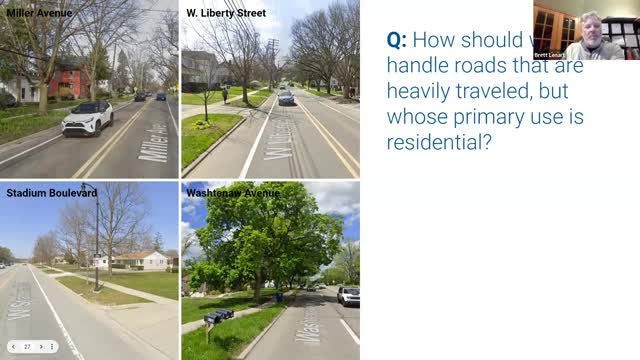
In a recent government meeting, officials discussed strategies for increasing housing density in transitional districts, particularly focusing on mid-rise developments. The conversation highlighted the potential for these areas to evolve more rapidly than traditional single-family neighborhoods, which are often constrained by lot sizes and existing market demand for larger homes.
Commissioners expressed concerns about the trend of larger homes, often referred to as \"McMansions,\" replacing smaller, modest houses in single-family neighborhoods. One commissioner noted that while there is a strong market for single-family homes, the current trend may not align with the community's long-term housing goals. The discussion emphasized the need for regulations that could encourage more diverse housing options, such as duplexes and quadplexes, rather than allowing the continued expansion of single-family homes.
The meeting also addressed the importance of balancing height limits and unit counts in new developments. Several commissioners argued that focusing on building form rather than strict unit limits could lead to more effective housing configurations. They suggested that allowing for greater heights could facilitate a mix of unit types, which would better serve the community's needs.
Additionally, the conversation touched on the necessity of integrating transportation policies with housing development to ensure that increased density does not overwhelm existing infrastructure. The commissioners acknowledged that as housing density increases, there will be a corresponding rise in traffic, making multimodal transit options essential for sustainable growth.
Overall, the meeting underscored a commitment to rethinking zoning regulations to foster a more diverse and efficient housing landscape while addressing community concerns about maintaining neighborhood character and livability.
Commissioners expressed concerns about the trend of larger homes, often referred to as \"McMansions,\" replacing smaller, modest houses in single-family neighborhoods. One commissioner noted that while there is a strong market for single-family homes, the current trend may not align with the community's long-term housing goals. The discussion emphasized the need for regulations that could encourage more diverse housing options, such as duplexes and quadplexes, rather than allowing the continued expansion of single-family homes.
The meeting also addressed the importance of balancing height limits and unit counts in new developments. Several commissioners argued that focusing on building form rather than strict unit limits could lead to more effective housing configurations. They suggested that allowing for greater heights could facilitate a mix of unit types, which would better serve the community's needs.
Additionally, the conversation touched on the necessity of integrating transportation policies with housing development to ensure that increased density does not overwhelm existing infrastructure. The commissioners acknowledged that as housing density increases, there will be a corresponding rise in traffic, making multimodal transit options essential for sustainable growth.
Overall, the meeting underscored a commitment to rethinking zoning regulations to foster a more diverse and efficient housing landscape while addressing community concerns about maintaining neighborhood character and livability.
Don't Miss a Word: See the Full Meeting!
Go beyond summaries. Unlock every video, transcript, and key insight with a Founder Membership.
✓
Get instant access to full meeting videos
✓
Search and clip any phrase from complete transcripts
✓
Receive AI-powered summaries & custom alerts
✓
Enjoy lifetime, unrestricted access to government data
30-day money-back guarantee
