Supreme Court reshapes executive power and agency authority
September 23, 2024 | Labor & Commerce, Senate, Legislative Sessions, Washington
This article was created by AI summarizing key points discussed. AI makes mistakes, so for full details and context, please refer to the video of the full meeting. Please report any errors so we can fix them. Report an error »
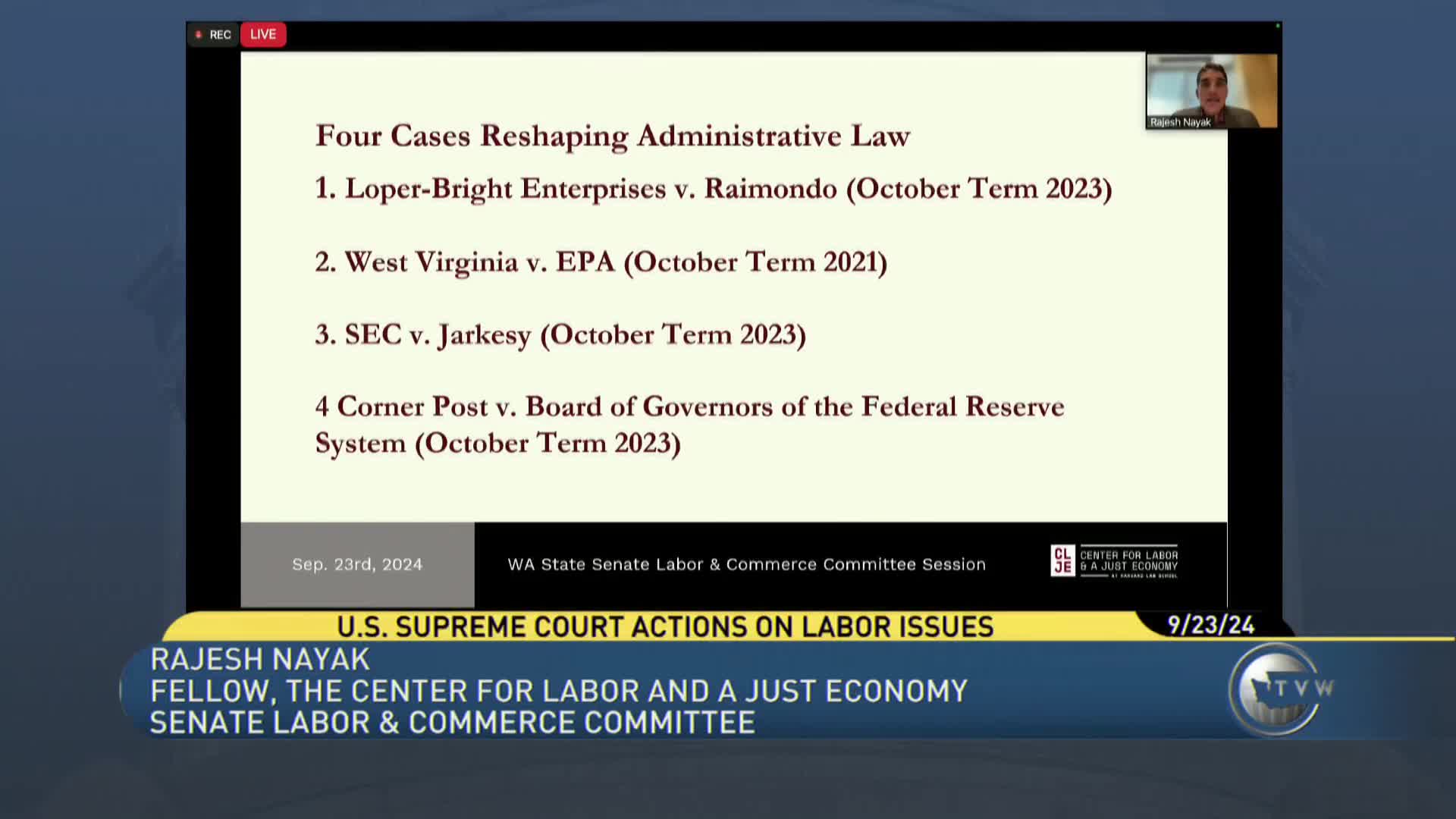
In a recent government meeting, officials discussed the significant impact of four recent Supreme Court decisions that have altered the landscape of executive action concerning federal workers. The discussions highlighted the increasing reliance on executive action by presidents from both parties, particularly in light of the challenges faced in passing bipartisan legislation in Congress.
The Supreme Court's decision to overrule the Chevron doctrine, established in the 1980s, was a focal point of the meeting. This doctrine previously allowed courts to defer to agency interpretations of ambiguous laws. The recent ruling in Oberbright v. Raimondo shifts this responsibility to judges, who are now expected to resolve legal ambiguities without the same level of deference to agency expertise. This change raises concerns about the ability of judges, who often lack the resources and specialized knowledge of agencies, to effectively interpret complex regulations.
The implications of this ruling are already being felt, as cases across the country are being remanded to district courts for reevaluation under the new standards. For instance, the Department of Labor's retirement rule, which permits fiduciaries to consider environmental, social, and governance factors in investment decisions, is now subject to renewed scrutiny. Additionally, the 5th Circuit's recent invalidation of a rule protecting tipped workers from lower wages further exemplifies the potential for increased litigation against agency actions.
The meeting also addressed the broader trend of judicial skepticism towards executive actions, particularly those that have been long-standing practices. The introduction of the \"major questions doctrine\" in cases like West Virginia v. EPA allows courts to invalidate agency actions unless there is clear congressional authorization, adding another layer of complexity to regulatory enforcement.
As the meeting concluded, officials emphasized the importance of state-level initiatives in light of these judicial changes, underscoring the need for continued advocacy and legislative efforts to protect workers' rights and uphold effective governance. The discussions reflect a growing concern about the balance of power between the judiciary and executive agencies, and the potential ramifications for federal workers and regulatory practices moving forward.
The Supreme Court's decision to overrule the Chevron doctrine, established in the 1980s, was a focal point of the meeting. This doctrine previously allowed courts to defer to agency interpretations of ambiguous laws. The recent ruling in Oberbright v. Raimondo shifts this responsibility to judges, who are now expected to resolve legal ambiguities without the same level of deference to agency expertise. This change raises concerns about the ability of judges, who often lack the resources and specialized knowledge of agencies, to effectively interpret complex regulations.
The implications of this ruling are already being felt, as cases across the country are being remanded to district courts for reevaluation under the new standards. For instance, the Department of Labor's retirement rule, which permits fiduciaries to consider environmental, social, and governance factors in investment decisions, is now subject to renewed scrutiny. Additionally, the 5th Circuit's recent invalidation of a rule protecting tipped workers from lower wages further exemplifies the potential for increased litigation against agency actions.
The meeting also addressed the broader trend of judicial skepticism towards executive actions, particularly those that have been long-standing practices. The introduction of the \"major questions doctrine\" in cases like West Virginia v. EPA allows courts to invalidate agency actions unless there is clear congressional authorization, adding another layer of complexity to regulatory enforcement.
As the meeting concluded, officials emphasized the importance of state-level initiatives in light of these judicial changes, underscoring the need for continued advocacy and legislative efforts to protect workers' rights and uphold effective governance. The discussions reflect a growing concern about the balance of power between the judiciary and executive agencies, and the potential ramifications for federal workers and regulatory practices moving forward.
Don't Miss a Word: See the Full Meeting!
Go beyond summaries. Unlock every video, transcript, and key insight with a Founder Membership.
✓
Get instant access to full meeting videos
✓
Search and clip any phrase from complete transcripts
✓
Receive AI-powered summaries & custom alerts
✓
Enjoy lifetime, unrestricted access to government data
30-day money-back guarantee
