City outlines ambitious budget for community and climate initiatives
September 12, 2024 | Boulder, Boulder County, Colorado
This article was created by AI summarizing key points discussed. AI makes mistakes, so for full details and context, please refer to the video of the full meeting. Please report any errors so we can fix them. Report an error »
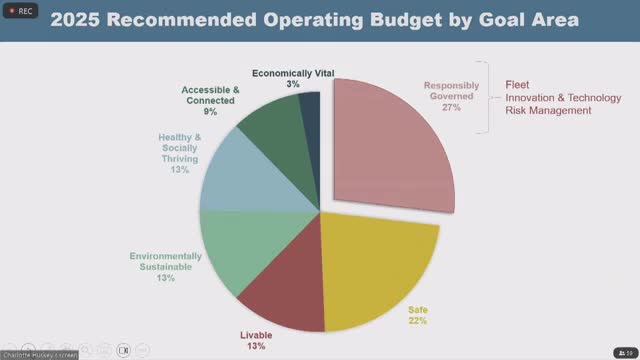
In a recent government meeting, city officials outlined key budgetary goals and initiatives for the upcoming fiscal year, emphasizing a commitment to responsible governance, community safety, livability, environmental sustainability, health, connectivity, and economic vitality.
The meeting began with a focus on internal services that support city operations, highlighting the fleet program responsible for maintaining over 1,000 city vehicles and the IT infrastructure that serves more than 1,500 employees. Risk management efforts were also discussed, aimed at minimizing exposure for city employees and residents.
A significant increase in funding was noted in the SAFE goal area, which aims to enhance community relations and emergency support. The budget for 2025 reflects a 4.3% increase, driven by investments in public safety operations, including the fire rescue department and a holistic approach to policing.
The livable category, which encompasses homelessness services and community investments, saw a substantial 24% increase, primarily due to enhanced funding for affordable housing initiatives. This category allocates $1 million annually to support nonprofit agencies serving low-income populations.
Environmental sustainability efforts were underscored with programs focused on wildfire resilience and water treatment, funded by a climate tax approved by voters. These initiatives aim to bolster climate resilience and public health through ecological stewardship.
The healthy and socially thriving goal area, which promotes well-being and access to recreational and cultural opportunities, experienced a 4.4% increase, largely attributed to an 86% rise in arts funding following the passage of the Arts, Culture, and Heritage Task.
The Accessible and Connected goal area, comprising 9% of the budget, focuses on transportation planning and communication programs, with a 7% increase driven by technology investments and enhancements to public transit services.
Lastly, the economically vital goal area, which supports small business development and economic strategies, also saw a 24% increase, reflecting the integration of the small business development center into city operations.
The meeting concluded with a brief overview of the six-year Capital Improvement Program (CIP), which supports over 200 projects with a total budget of $807.4 million. The 2025 budget alone allocates $190.2 million, with significant investments directed towards utilities, transportation, and facilities.
Overall, the discussions highlighted a comprehensive approach to city governance, focusing on enhancing community services, safety, and sustainability while fostering economic growth and cultural vibrancy.
The meeting began with a focus on internal services that support city operations, highlighting the fleet program responsible for maintaining over 1,000 city vehicles and the IT infrastructure that serves more than 1,500 employees. Risk management efforts were also discussed, aimed at minimizing exposure for city employees and residents.
A significant increase in funding was noted in the SAFE goal area, which aims to enhance community relations and emergency support. The budget for 2025 reflects a 4.3% increase, driven by investments in public safety operations, including the fire rescue department and a holistic approach to policing.
The livable category, which encompasses homelessness services and community investments, saw a substantial 24% increase, primarily due to enhanced funding for affordable housing initiatives. This category allocates $1 million annually to support nonprofit agencies serving low-income populations.
Environmental sustainability efforts were underscored with programs focused on wildfire resilience and water treatment, funded by a climate tax approved by voters. These initiatives aim to bolster climate resilience and public health through ecological stewardship.
The healthy and socially thriving goal area, which promotes well-being and access to recreational and cultural opportunities, experienced a 4.4% increase, largely attributed to an 86% rise in arts funding following the passage of the Arts, Culture, and Heritage Task.
The Accessible and Connected goal area, comprising 9% of the budget, focuses on transportation planning and communication programs, with a 7% increase driven by technology investments and enhancements to public transit services.
Lastly, the economically vital goal area, which supports small business development and economic strategies, also saw a 24% increase, reflecting the integration of the small business development center into city operations.
The meeting concluded with a brief overview of the six-year Capital Improvement Program (CIP), which supports over 200 projects with a total budget of $807.4 million. The 2025 budget alone allocates $190.2 million, with significant investments directed towards utilities, transportation, and facilities.
Overall, the discussions highlighted a comprehensive approach to city governance, focusing on enhancing community services, safety, and sustainability while fostering economic growth and cultural vibrancy.
Don't Miss a Word: See the Full Meeting!
Go beyond summaries. Unlock every video, transcript, and key insight with a Founder Membership.
✓
Get instant access to full meeting videos
✓
Search and clip any phrase from complete transcripts
✓
Receive AI-powered summaries & custom alerts
✓
Enjoy lifetime, unrestricted access to government data
30-day money-back guarantee
