Residents Rally Against Controversial Housing Development Plan
November 15, 2024 | Planning Meetings, Knoxville City, Knox County, Tennessee
This article was created by AI summarizing key points discussed. AI makes mistakes, so for full details and context, please refer to the video of the full meeting. Please report any errors so we can fix them. Report an error »
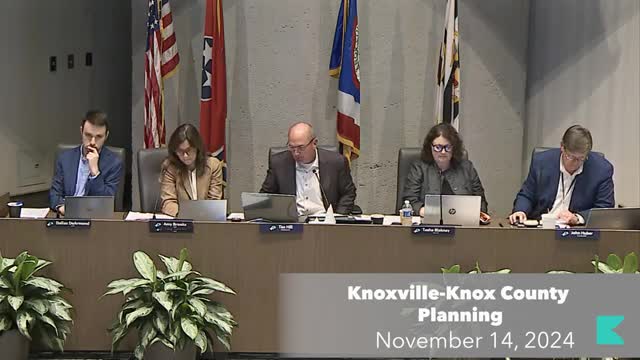
In a recent government meeting, a proposed residential development plan for an 85-acre site in Knoxville sparked significant discussion among officials and community members. The plan, which seeks to establish a single-family detached subdivision with up to 169 lots, is currently zoned for planned residential use, allowing for two dwelling units per acre.
The proposal includes three motions for approval: the first to accept alternative design standards, the second to approve the concept plan with 14 conditions, and the third to endorse the development plan for 161 detached residential lots and eight estate lots. The applicant, Greg Presnell, emphasized that the development has been designed in consultation with local planning and engineering departments, and he acknowledged the need for improvements to nearby roads, particularly Pickens Gap, which is currently narrow.
However, the plan faced opposition from local residents, including Bobby Smelzer, who expressed concerns about the density of the proposed lots, which are planned to be as small as 4,200 square feet—below the city’s minimum requirement of 5,000 square feet for city lots. Smelzer argued that the development lacks essential community amenities such as sidewalks, playgrounds, and recreational facilities, which he believes are vital for a healthy neighborhood environment.
Another resident, Charlotte Ott, raised concerns about potential discrepancies in property lines due to mapping errors, suggesting that the approval of the development should be delayed until these issues are resolved.
Commissioners discussed the importance of community benefits in planned residential developments, noting that while amenities are not mandatory, they are encouraged. Some officials acknowledged the market demand for smaller lots, citing a trend where potential buyers prefer less maintenance.
The meeting highlighted the ongoing tension between development needs and community desires, as officials weigh the benefits of increased housing against the concerns of existing residents regarding density and infrastructure. The commission is expected to deliberate further on the motions presented, taking into account both the applicant's proposals and the community's feedback.
The proposal includes three motions for approval: the first to accept alternative design standards, the second to approve the concept plan with 14 conditions, and the third to endorse the development plan for 161 detached residential lots and eight estate lots. The applicant, Greg Presnell, emphasized that the development has been designed in consultation with local planning and engineering departments, and he acknowledged the need for improvements to nearby roads, particularly Pickens Gap, which is currently narrow.
However, the plan faced opposition from local residents, including Bobby Smelzer, who expressed concerns about the density of the proposed lots, which are planned to be as small as 4,200 square feet—below the city’s minimum requirement of 5,000 square feet for city lots. Smelzer argued that the development lacks essential community amenities such as sidewalks, playgrounds, and recreational facilities, which he believes are vital for a healthy neighborhood environment.
Another resident, Charlotte Ott, raised concerns about potential discrepancies in property lines due to mapping errors, suggesting that the approval of the development should be delayed until these issues are resolved.
Commissioners discussed the importance of community benefits in planned residential developments, noting that while amenities are not mandatory, they are encouraged. Some officials acknowledged the market demand for smaller lots, citing a trend where potential buyers prefer less maintenance.
The meeting highlighted the ongoing tension between development needs and community desires, as officials weigh the benefits of increased housing against the concerns of existing residents regarding density and infrastructure. The commission is expected to deliberate further on the motions presented, taking into account both the applicant's proposals and the community's feedback.
Don't Miss a Word: See the Full Meeting!
Go beyond summaries. Unlock every video, transcript, and key insight with a Founder Membership.
✓
Get instant access to full meeting videos
✓
Search and clip any phrase from complete transcripts
✓
Receive AI-powered summaries & custom alerts
✓
Enjoy lifetime, unrestricted access to government data
30-day money-back guarantee
