Land value tax proposal aims to revitalize Spokane economy
November 21, 2024 | Spokane, Spokane County, Washington
This article was created by AI summarizing key points discussed. AI makes mistakes, so for full details and context, please refer to the video of the full meeting. Please report any errors so we can fix them. Report an error »
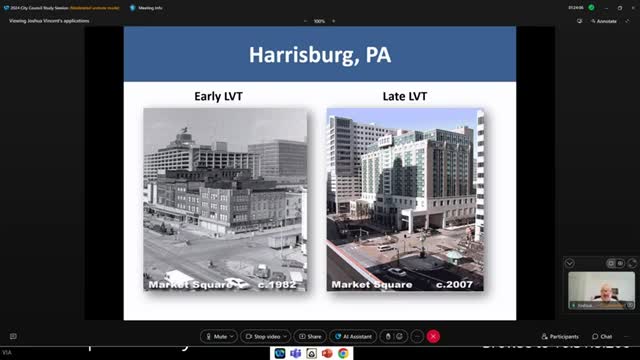
In a recent government meeting, discussions centered on the potential implementation of a land value tax (LVT) in Spokane, Washington, aimed at revitalizing the city’s economy and addressing the issue of vacant lots. Advocates for the LVT highlighted its ability to incentivize development by taxing land rather than buildings, contrasting it with the traditional property tax system that penalizes investment.
The meeting featured a comparison between Spokane and other cities like Harrisburg and Albany, which share similar post-industrial characteristics. Proponents cited a study by economists Oates and Schwab, which demonstrated that cities with a land value tax, such as Pittsburgh, experienced growth in building permits even after the decline of the steel industry, unlike their counterparts that relied on traditional property taxes.
The proposed LVT would maintain the same tax rate for vacant lots while significantly reducing taxes for developed properties. This shift aims to encourage landowners to develop their properties rather than hold onto them, thereby increasing the overall tax revenue generated from land. The meeting underscored the prevalence of underutilized land in Spokane, with many vacant lots contributing little to the city’s tax base.
Supporters argued that the LVT could lead to a more stable revenue stream for the city, as land values tend to be more consistent than property values. They emphasized that this tax model has been successfully implemented in various locations, including cities in Pennsylvania and even Canberra, Australia, which has relied solely on land value taxation for over a century.
The discussion also touched on the need for a gradual transition to the LVT to accommodate current property owners and developers who have made plans based on existing tax structures. This phased approach would allow stakeholders to adjust to the new system without abrupt financial impacts.
The meeting concluded with a call for further research into the feasibility of implementing a land value tax in Spokane, with plans to engage with local finance and planning departments to explore the potential benefits and logistics of such a shift.
The meeting featured a comparison between Spokane and other cities like Harrisburg and Albany, which share similar post-industrial characteristics. Proponents cited a study by economists Oates and Schwab, which demonstrated that cities with a land value tax, such as Pittsburgh, experienced growth in building permits even after the decline of the steel industry, unlike their counterparts that relied on traditional property taxes.
The proposed LVT would maintain the same tax rate for vacant lots while significantly reducing taxes for developed properties. This shift aims to encourage landowners to develop their properties rather than hold onto them, thereby increasing the overall tax revenue generated from land. The meeting underscored the prevalence of underutilized land in Spokane, with many vacant lots contributing little to the city’s tax base.
Supporters argued that the LVT could lead to a more stable revenue stream for the city, as land values tend to be more consistent than property values. They emphasized that this tax model has been successfully implemented in various locations, including cities in Pennsylvania and even Canberra, Australia, which has relied solely on land value taxation for over a century.
The discussion also touched on the need for a gradual transition to the LVT to accommodate current property owners and developers who have made plans based on existing tax structures. This phased approach would allow stakeholders to adjust to the new system without abrupt financial impacts.
The meeting concluded with a call for further research into the feasibility of implementing a land value tax in Spokane, with plans to engage with local finance and planning departments to explore the potential benefits and logistics of such a shift.
View the Full Meeting & All Its Details
This article offers just a summary. Unlock complete video, transcripts, and insights as a Founder Member.
✓
Watch full, unedited meeting videos
✓
Search every word spoken in unlimited transcripts
✓
AI summaries & real-time alerts (all government levels)
✓
Permanent access to expanding government content
30-day money-back guarantee
