Accessibility Ramp Proposal Sparks Debate in Historic District
October 29, 2024 | Land Preservation Commission, New York City Board & Committees, New York City, New York County, New York
This article was created by AI summarizing key points discussed. AI makes mistakes, so for full details and context, please refer to the video of the full meeting. Please report any errors so we can fix them. Report an error »
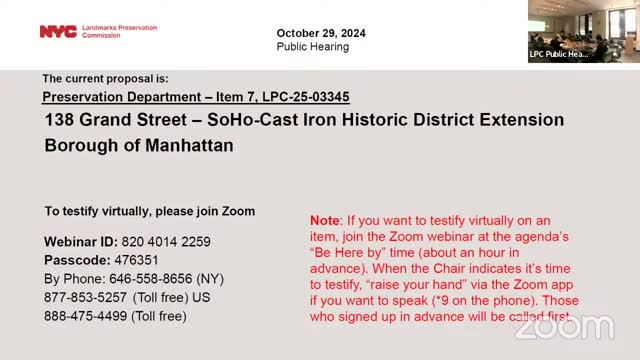
In a recent government meeting, the commission reviewed two significant applications for modifications to historic buildings in New York City, focusing on accessibility and preservation.
The first application involved the installation of a barrier-free access ramp at 138 Grand Street, located in the SoHo cast iron historic district. The proposed ramp, designed with a switchback layout to avoid interfering with adjacent entrances, will be constructed from galvanized steel and will not impact the existing sidewalk or underlying vault lights. The design aims to blend with the building's aesthetic while ensuring compliance with accessibility standards. Public testimony included recommendations from the Manhattan Community Board to modify the ramp's design to minimize its visual impact, such as adjusting the railing posts and considering lighter materials. Despite these suggestions, the applicant expressed concerns about maintenance issues related to painted finishes. Ultimately, the commission unanimously approved the ramp, emphasizing the importance of accessibility without compromising the building's historic character.
The second application pertained to 70 Perry Street in the Greenwich Village Historic District, where the proposal sought to modify the entrance doors by replacing wooden panels with glass lights. The architect argued that this change would enhance natural light and security for residents. However, public testimony raised concerns about altering the historic wood doors, with some advocating for the preservation of the existing panels. The commission acknowledged the importance of the modifications while also considering the preservation of the original materials. They noted the applicant's willingness to store the removed panels for potential future restoration and expressed interest in incorporating beveled glass to maintain the aesthetic integrity of the entrance. The commission ultimately deemed the proposal appropriate, highlighting the balance between modernization and historical preservation.
Both discussions underscored the ongoing challenge of maintaining the delicate balance between accessibility improvements and the preservation of New York City's rich architectural heritage.
The first application involved the installation of a barrier-free access ramp at 138 Grand Street, located in the SoHo cast iron historic district. The proposed ramp, designed with a switchback layout to avoid interfering with adjacent entrances, will be constructed from galvanized steel and will not impact the existing sidewalk or underlying vault lights. The design aims to blend with the building's aesthetic while ensuring compliance with accessibility standards. Public testimony included recommendations from the Manhattan Community Board to modify the ramp's design to minimize its visual impact, such as adjusting the railing posts and considering lighter materials. Despite these suggestions, the applicant expressed concerns about maintenance issues related to painted finishes. Ultimately, the commission unanimously approved the ramp, emphasizing the importance of accessibility without compromising the building's historic character.
The second application pertained to 70 Perry Street in the Greenwich Village Historic District, where the proposal sought to modify the entrance doors by replacing wooden panels with glass lights. The architect argued that this change would enhance natural light and security for residents. However, public testimony raised concerns about altering the historic wood doors, with some advocating for the preservation of the existing panels. The commission acknowledged the importance of the modifications while also considering the preservation of the original materials. They noted the applicant's willingness to store the removed panels for potential future restoration and expressed interest in incorporating beveled glass to maintain the aesthetic integrity of the entrance. The commission ultimately deemed the proposal appropriate, highlighting the balance between modernization and historical preservation.
Both discussions underscored the ongoing challenge of maintaining the delicate balance between accessibility improvements and the preservation of New York City's rich architectural heritage.
Don't Miss a Word: See the Full Meeting!
Go beyond summaries. Unlock every video, transcript, and key insight with a Founder Membership.
✓
Get instant access to full meeting videos
✓
Search and clip any phrase from complete transcripts
✓
Receive AI-powered summaries & custom alerts
✓
Enjoy lifetime, unrestricted access to government data
30-day money-back guarantee
