New eviction law sparks debate over tenant protections
November 20, 2024 | Columbia County, New York
This article was created by AI summarizing key points discussed. AI makes mistakes, so for full details and context, please refer to the video of the full meeting. Please report any errors so we can fix them. Report an error »
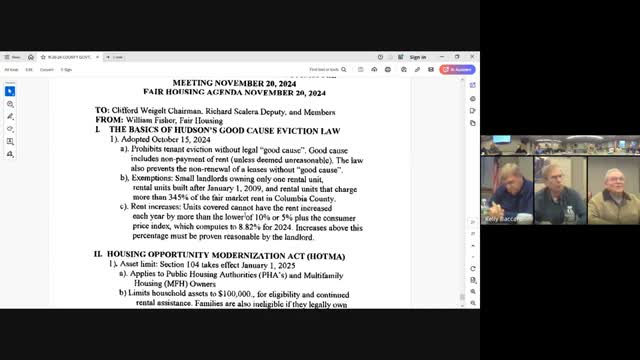
In a recent government meeting, officials discussed the implications of the new good cause eviction law, which has been adopted by several municipalities, including Hudson, Kingston, and Ithaca. This law introduces significant changes to landlord-tenant relationships, particularly regarding lease non-renewals and rent increases.
Under the new regulations, landlords must provide a valid reason for not renewing a lease, a shift from previous practices where they could simply choose not to renew without explanation. This change aims to enhance tenant protections, addressing concerns raised by many tenants who felt left in the dark about their lease statuses.
The meeting highlighted the distinction between small landlords and larger property owners. While state law defines small landlords as those owning ten or fewer properties, Hudson has set its threshold at just two units. This means that landlords with one rental unit are now subject to the good cause eviction law, expanding tenant protections significantly within the city.
Another critical aspect discussed was the rent cap, which limits increases to 5% plus the consumer price index, currently estimated at approximately 8.82% for 2024. Landlords seeking to raise rents beyond this cap must justify their increases in court, presenting financial statements to prove the necessity of the hike based on operating costs.
Exemptions to the law were also addressed, including units charging more than 345% of the fair market rent as determined by HUD, which is higher than the state’s 245% threshold. Additionally, subsidized rents and owner-occupied units are exempt from these regulations.
Concerns were raised about the potential negative impacts of the law, particularly on vulnerable populations such as the elderly and individuals with disabilities. Critics worry that landlords may become hesitant to rent to these groups due to the increased regulatory burden.
As municipalities continue to adopt the good cause eviction law, the meeting underscored the need for clarity and understanding of the new regulations, which are expected to be tested in court as landlords and tenants navigate this evolving legal landscape. The discussion concluded with a mention of the upcoming Housing Opportunity Modernization Act, indicating further changes may be on the horizon for housing regulations.
Under the new regulations, landlords must provide a valid reason for not renewing a lease, a shift from previous practices where they could simply choose not to renew without explanation. This change aims to enhance tenant protections, addressing concerns raised by many tenants who felt left in the dark about their lease statuses.
The meeting highlighted the distinction between small landlords and larger property owners. While state law defines small landlords as those owning ten or fewer properties, Hudson has set its threshold at just two units. This means that landlords with one rental unit are now subject to the good cause eviction law, expanding tenant protections significantly within the city.
Another critical aspect discussed was the rent cap, which limits increases to 5% plus the consumer price index, currently estimated at approximately 8.82% for 2024. Landlords seeking to raise rents beyond this cap must justify their increases in court, presenting financial statements to prove the necessity of the hike based on operating costs.
Exemptions to the law were also addressed, including units charging more than 345% of the fair market rent as determined by HUD, which is higher than the state’s 245% threshold. Additionally, subsidized rents and owner-occupied units are exempt from these regulations.
Concerns were raised about the potential negative impacts of the law, particularly on vulnerable populations such as the elderly and individuals with disabilities. Critics worry that landlords may become hesitant to rent to these groups due to the increased regulatory burden.
As municipalities continue to adopt the good cause eviction law, the meeting underscored the need for clarity and understanding of the new regulations, which are expected to be tested in court as landlords and tenants navigate this evolving legal landscape. The discussion concluded with a mention of the upcoming Housing Opportunity Modernization Act, indicating further changes may be on the horizon for housing regulations.
View the Full Meeting & All Its Details
This article offers just a summary. Unlock complete video, transcripts, and insights as a Founder Member.
✓
Watch full, unedited meeting videos
✓
Search every word spoken in unlimited transcripts
✓
AI summaries & real-time alerts (all government levels)
✓
Permanent access to expanding government content
30-day money-back guarantee
