Water quality crisis prompts urgent monitoring and advisories
December 05, 2024 | California Water Quality Monitoring Council, Boards and Commissions, Executive, California
This article was created by AI summarizing key points discussed. AI makes mistakes, so for full details and context, please refer to the video of the full meeting. Please report any errors so we can fix them. Report an error »
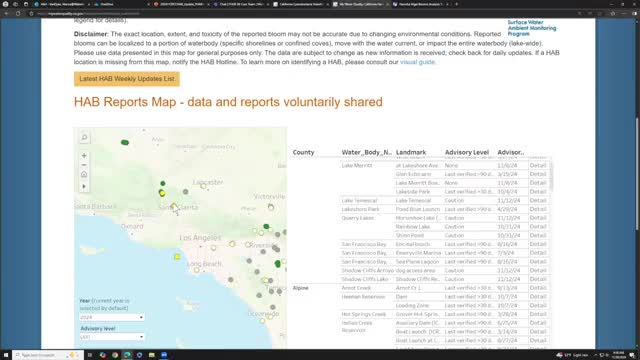
The California Water Quality Monitoring Council convened on December 5, 2024, for the Fall 2024 CCHAB Network Meeting, focusing on water quality monitoring efforts across various regions. The meeting highlighted ongoing partnerships and monitoring programs aimed at addressing water quality issues, particularly concerning harmful algal blooms and toxin levels in lakes and rivers.
The meeting commenced with updates from Region 4, where representatives reported on monitoring activities at Pyramid Lake and Quail Lake. They noted the detection of red tide and emphasized collaboration with local partners to coordinate responses. Additionally, monitoring efforts with Los Angeles City and County Parks were discussed, aimed at assessing the safety of park lakes.
Dana Schultz from the Central Valley Regional Water Board presented two significant partner monitoring programs conducted over the summer. The first involved a collaboration with Restore the Delta, which monitored the Stockton waterfront and San Joaquin River. Weekly sampling revealed two instances of microcystin, with one requiring a caution advisory. The second program, in partnership with Tulare County Environmental Health, focused on Lake Cahuilla and the Cahuilla River, analyzing samples for various toxins.
The meeting continued with a review of pre-holiday assessments conducted by Region 5, which sampled Hensley and Eastman Lakes, among others. Results indicated no advisories for Hensley Lake, while Eastman Lake had a caution advisory. Clear Lake also showed mixed results, with one site under a danger advisory.
Region 6 provided a seasonal review, detailing the number of water bodies monitored and the advisories issued. Notably, high microcystin levels were reported at Bridgeport Reservoir and Crowley Lake, prompting danger advisories. The region also highlighted an increase in reported illnesses related to water quality, necessitating further investigation.
The meeting concluded with acknowledgments of the collaborative efforts among various monitoring programs and partners, underscoring the importance of these initiatives in ensuring public safety and environmental health. The council plans to continue these monitoring efforts and will reconvene to discuss further findings and strategies in the upcoming year.
The meeting commenced with updates from Region 4, where representatives reported on monitoring activities at Pyramid Lake and Quail Lake. They noted the detection of red tide and emphasized collaboration with local partners to coordinate responses. Additionally, monitoring efforts with Los Angeles City and County Parks were discussed, aimed at assessing the safety of park lakes.
Dana Schultz from the Central Valley Regional Water Board presented two significant partner monitoring programs conducted over the summer. The first involved a collaboration with Restore the Delta, which monitored the Stockton waterfront and San Joaquin River. Weekly sampling revealed two instances of microcystin, with one requiring a caution advisory. The second program, in partnership with Tulare County Environmental Health, focused on Lake Cahuilla and the Cahuilla River, analyzing samples for various toxins.
The meeting continued with a review of pre-holiday assessments conducted by Region 5, which sampled Hensley and Eastman Lakes, among others. Results indicated no advisories for Hensley Lake, while Eastman Lake had a caution advisory. Clear Lake also showed mixed results, with one site under a danger advisory.
Region 6 provided a seasonal review, detailing the number of water bodies monitored and the advisories issued. Notably, high microcystin levels were reported at Bridgeport Reservoir and Crowley Lake, prompting danger advisories. The region also highlighted an increase in reported illnesses related to water quality, necessitating further investigation.
The meeting concluded with acknowledgments of the collaborative efforts among various monitoring programs and partners, underscoring the importance of these initiatives in ensuring public safety and environmental health. The council plans to continue these monitoring efforts and will reconvene to discuss further findings and strategies in the upcoming year.
View the Full Meeting & All Its Details
This article offers just a summary. Unlock complete video, transcripts, and insights as a Founder Member.
✓
Watch full, unedited meeting videos
✓
Search every word spoken in unlimited transcripts
✓
AI summaries & real-time alerts (all government levels)
✓
Permanent access to expanding government content
30-day money-back guarantee
