Nuclear power debate heats up over Diablo Canyon operations
December 06, 2024 | San Diego Community Power, San Diego County, California
This article was created by AI summarizing key points discussed. AI makes mistakes, so for full details and context, please refer to the video of the full meeting. Please report any errors so we can fix them. Report an error »
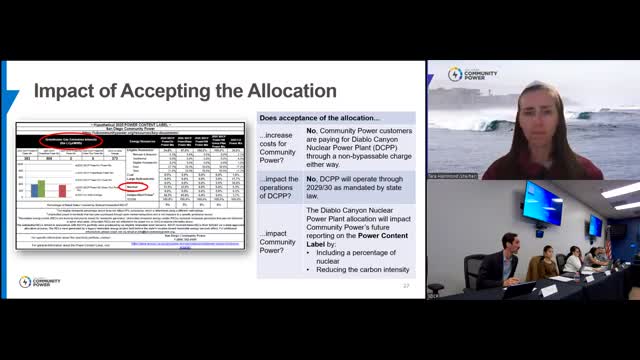
The San Diego Community Power (SDCP) Advisory Committee meeting on December 5, 2024, spotlighted a pivotal decision regarding the future of energy sourcing in the region. The committee discussed the implications of accepting nuclear energy attributes from the Diablo Canyon nuclear power plant, which is set to operate until 2030 under state law. This decision, while framed as a means to reduce greenhouse gas emissions, sparked significant debate among committee members.
Byron, the Chief Commercial Officer, emphasized that accepting these nuclear attributes could lead to a substantial reduction in carbon intensity for SDCP's power portfolio—projected at around 20%. He noted that this move would not affect the operations of Diablo Canyon, which is already generating power, and would allow SDCP to benefit from a financial boost estimated between $40 million to $50 million annually. This allocation would provide approximately 900,000 megawatt hours of nuclear power attributes each year, equating to about 12% of SDCP's energy mix.
However, the proposal faced strong opposition from committee member Mayor Anderson, who raised serious concerns about the safety and environmental implications of nuclear energy. Citing his extensive background in nuclear waste management, he argued that the energy produced by Diablo Canyon is not as clean as claimed, highlighting the environmental costs associated with uranium mining and the long-term storage of nuclear waste. Anderson described the notion of nuclear energy as greenhouse gas-free as misleading, asserting that the risks posed by nuclear waste far outweigh the benefits.
Despite the contentious discussions, the committee is poised to recommend to the board the acceptance of the nuclear allocation, which would be executed by CEO Karen. The outcome of this decision could significantly shape SDCP's energy strategy and its commitment to renewable energy goals, which aim for over 50% renewable sources by 2027 and 100% by 2035. As the debate continues, the implications of integrating nuclear energy into the community's power portfolio remain a critical point of contention.
Byron, the Chief Commercial Officer, emphasized that accepting these nuclear attributes could lead to a substantial reduction in carbon intensity for SDCP's power portfolio—projected at around 20%. He noted that this move would not affect the operations of Diablo Canyon, which is already generating power, and would allow SDCP to benefit from a financial boost estimated between $40 million to $50 million annually. This allocation would provide approximately 900,000 megawatt hours of nuclear power attributes each year, equating to about 12% of SDCP's energy mix.
However, the proposal faced strong opposition from committee member Mayor Anderson, who raised serious concerns about the safety and environmental implications of nuclear energy. Citing his extensive background in nuclear waste management, he argued that the energy produced by Diablo Canyon is not as clean as claimed, highlighting the environmental costs associated with uranium mining and the long-term storage of nuclear waste. Anderson described the notion of nuclear energy as greenhouse gas-free as misleading, asserting that the risks posed by nuclear waste far outweigh the benefits.
Despite the contentious discussions, the committee is poised to recommend to the board the acceptance of the nuclear allocation, which would be executed by CEO Karen. The outcome of this decision could significantly shape SDCP's energy strategy and its commitment to renewable energy goals, which aim for over 50% renewable sources by 2027 and 100% by 2035. As the debate continues, the implications of integrating nuclear energy into the community's power portfolio remain a critical point of contention.
Don't Miss a Word: See the Full Meeting!
Go beyond summaries. Unlock every video, transcript, and key insight with a Founder Membership.
✓
Get instant access to full meeting videos
✓
Search and clip any phrase from complete transcripts
✓
Receive AI-powered summaries & custom alerts
✓
Enjoy lifetime, unrestricted access to government data
30-day money-back guarantee
